Effluent and grinder pumps
Replacement of failed pumps on pressurised, mound and sand filter systems, sized and specified to the design rather than to whatever is on the van.
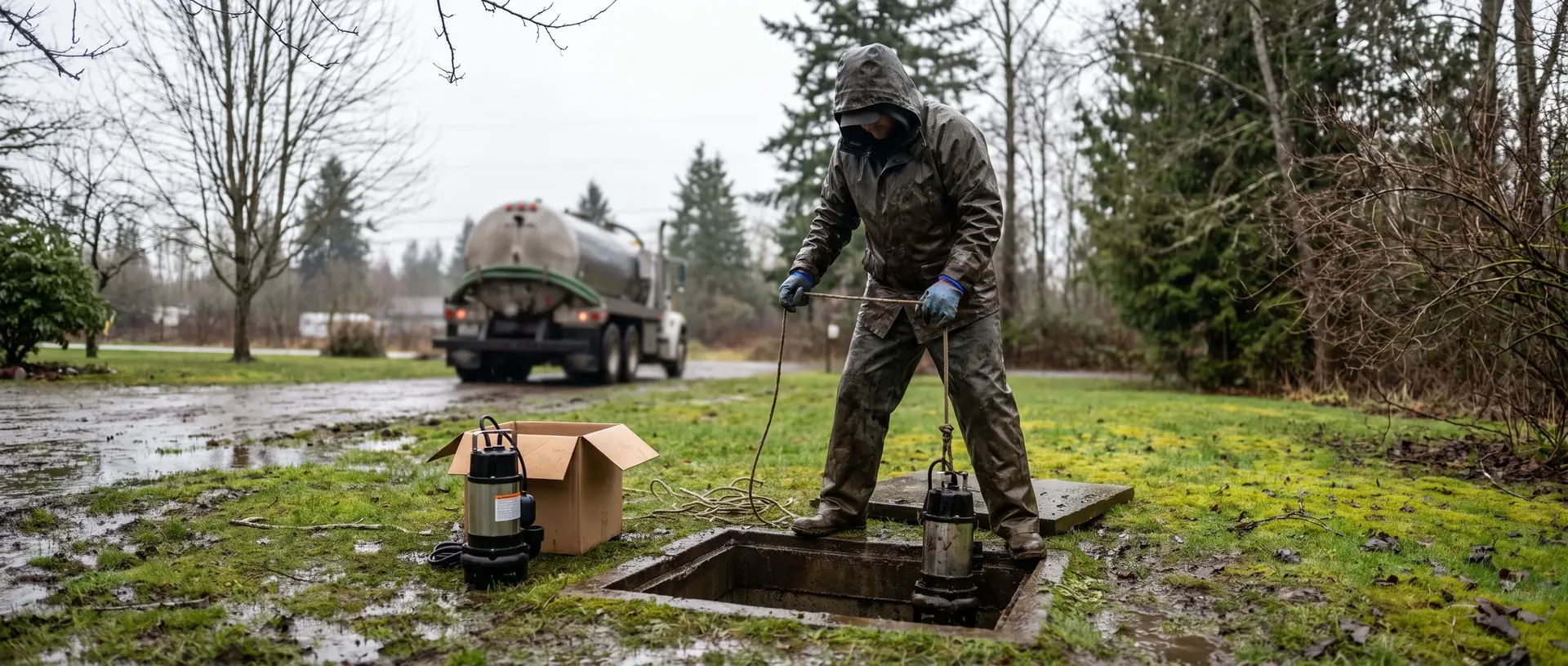
Septic service
If the alarm on the side of the house is going, something has stopped moving. Usually a pump or a float, and usually fixable the same visit.
01Why it matters
Not every septic system has a pump. Conventional gravity systems do not. But a large number of systems in this county are pressurised, mound or sand filter designs, because the ground here often will not take a simple gravity field. Those all rely on a pump to move effluent, and pumps fail.
When one does, liquid stops leaving the chamber, the level rises, and a float triggers the alarm. That alarm is doing you an enormous favour. It is warning you before the tank overflows, and it typically gives you a day or so of normal water use to get someone out.
That is the correct way to think about it. An alarm is not the emergency, it is the warning that precedes one. Ignore it or mute it and you get the emergency.
The good news is that the fix is usually at the cheaper end. Tripped breakers, stuck floats and failed pumps account for most alarm calls, and all three are resolved on a single visit.
02Scope
Replacement of failed pumps on pressurised, mound and sand filter systems, sized and specified to the design rather than to whatever is on the van.
Float switches, tethers and control panels. Stuck or fouled floats are one of the most common causes of both false alarms and genuine ones.
Alarm panels, audible and visual alarms, and the wiring between the panel and the chamber. Also the very common case where the alarm circuit and the pump circuit are on different breakers and only one has tripped.
03Included
Breakers, panel condition and the pump circuit checked before anything is condemned. A surprising share of alarm calls are a tripped breaker.
Chamber opened, level checked, floats inspected and cleaned, pump pulled and tested.
What failed, why, and what the replacement options are including whether the existing specification was right in the first place.
New pump or component fitted, floats set at the correct levels, system run through a full cycle and the alarm tested before we leave.

04How it runs
Most routine visits follow this exact sequence. If yours will not, we say so when you book rather than on the day.
What the alarm is doing, whether it is audible or a light, and whether drains are still working. We will ask you to check the breaker before we dispatch, because sometimes that is the whole fix.
Breakers, panel and circuit checked on arrival.
Level assessed, floats inspected and cleaned, pump pulled.
Pump bench tested and the float operation checked through its range.
Failed component replaced, floats reset to the correct levels for the design.
System run through a complete pump cycle and the alarm deliberately triggered and cleared, so you know it will warn you next time.
05Why us
We check the breaker first, including over the phone. It costs us callouts and it is obviously right. A homeowner should not pay for a truck to come out and flip a switch they could have flipped themselves.
We size replacements to the design. A pump is not a generic part. Head, flow and duty all come from the system design, and fitting something approximately similar because it was in stock produces a system that either fails early or does not dose the field correctly.
We set the floats properly. Float levels determine dose volume and the alarm point. Set carelessly, you get a system that either short cycles and wears the pump out or does not warn you until it is far too late.
And we test the alarm before we leave. An alarm that has not been tested is not a warning system, it is a decoration. It gets triggered deliberately and cleared so you know it works.
Check the breaker for the pump first. If that is not it, call us today rather than muting it and hoping.
06What customers say
Placeholder section.No reviews have been collected yet, and nothing here is invented to fill the space. Real customer reviews go in before this section publishes. Until then there is no star rating, no aggregate score and no review markup on this site.
07Questions
The liquid level in the pump chamber has risen past the alarm float. That normally means the pump has failed, a float is stuck, or a breaker has tripped. Occasionally it means the drain field has stopped accepting flow.
For a short period, cautiously. The alarm exists to give you time, and most systems have some reserve capacity above the alarm float. Reduce water use, avoid laundry and long showers, and get someone out the same day.
Commonly around a decade, though it varies widely with duty cycle and how well the floats were set. A pump that short cycles because of badly set floats wears out far sooner.
You can silence the audible alarm to stop the noise, and most panels have a button for exactly that. Silencing it is not fixing it, and the warning light should stay on until the problem is resolved.
Overdue pumping, blocked effluent filters, failed baffles, and on pressurised systems, pump and float failure. Pump and float issues are the most common source of alarm calls specifically.
Yes, and a pressurised system needs more than a gravity one. Pumping, effluent filter cleaning, and periodic checking of the pump, floats and alarm are all part of keeping one working.
08Coverage
We cover Bellingham, Lynden, Ferndale, Blaine, Birch Bay, Everson, Nooksack, Sumas, Deming, Custer, Sudden Valley and Point Roberts. Pressurised and mound systems are common on the wetter, flatter ground in the north of the county.
09Related
Every other service we run, in case the job you have is not the one you came here for.
Routine and overdue pumping. Both chambers, lids dug out at no extra charge, and the tank inspected while it is open.
Property transfer and routine inspections, with a written report escrow and the county can both act on.
Baffles, lids, risers, pumps, alarms and blocked lines. We diagnose before anyone quotes a replacement.
Whether a saturated field can be recovered or genuinely needs replacing, and the evidence for the call.
New systems from site evaluation and soil testing through design, permit and final county inspection.
Full replacement when a system is finished, including decommissioning the old tank properly.
Backing up, alarm sounding, sewage surfacing. Same day response, priced before we start.
Finding a buried system on a property where nobody knows where anything is, and tracking down the as-built.
Lids brought to ground level so future service does not start with an hour of digging.
Test pits, soil logs, a design the ground will support, and a permit package the county will accept.
10Book it
Tell us what the alarm is doing and whether the drains are still working normally.