Full system replacement
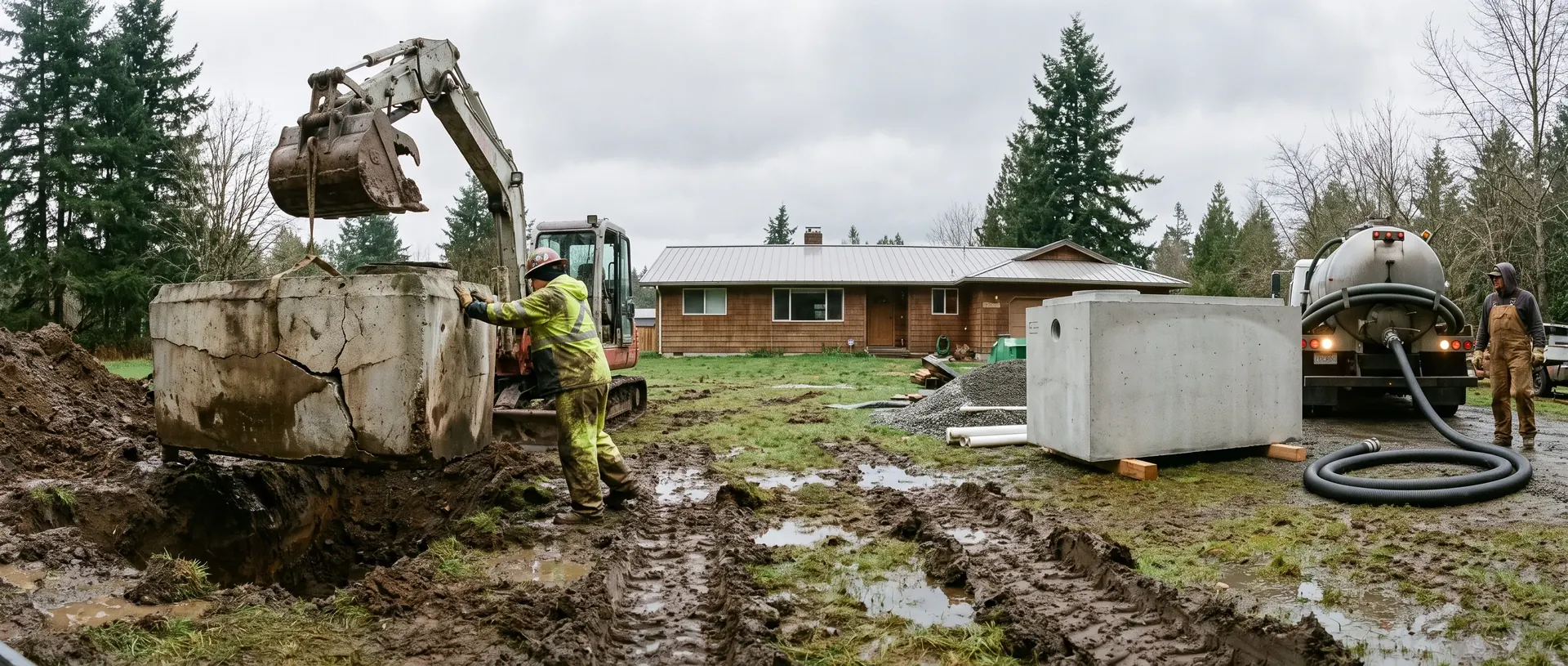
New tank and new drain field where both are finished, including decommissioning the old tank to the required standard rather than leaving it in the ground as a hazard.
Septic service
When a system is genuinely finished. Old one decommissioned, new one designed and permitted, and the yard put back.
01Why it matters
This is the biggest bill on the site, so it deserves the most scepticism. Before anyone replaces a system, three things should have been ruled out: an overdue tank feeding solids into the field, a mechanical failure such as a pump or a blocked filter, and groundwater overwhelming a field that would otherwise be fine.
We rule those out first, on every job, because a replacement quoted without that work is a guess with a large number attached.
Sometimes the answer really is replacement. Tanks crack and fail structurally. Drain fields that have been fed solids for two decades have clogged soil that will not recover. Systems installed to standards from fifty years ago are sometimes simply undersized for a house that has been extended twice.
When that is the case, the job is bigger than digging a hole. There is a design, a county permit, the old system to decommission properly, and a yard to put back together. We handle all of it as one piece of work.
02Scope
New tank and new drain field where both are finished, including decommissioning the old tank to the required standard rather than leaving it in the ground as a hazard.
Where the tank is sound and only the field has failed. Cheaper, faster, and far more common than full replacement. Covered in more depth on our drain field page.
Where the original system type is no longer viable on the site, replacing it with pressure distribution, a sand filter or a mound. This is often the outcome on wet or tight lots.
03Included
Tank assessed, mechanical causes ruled out, groundwater separated from failure. If we can save it we will tell you.
Soil testing, usable area established with setbacks respected, and a system designed for what the ground will actually accept now rather than what was acceptable decades ago.
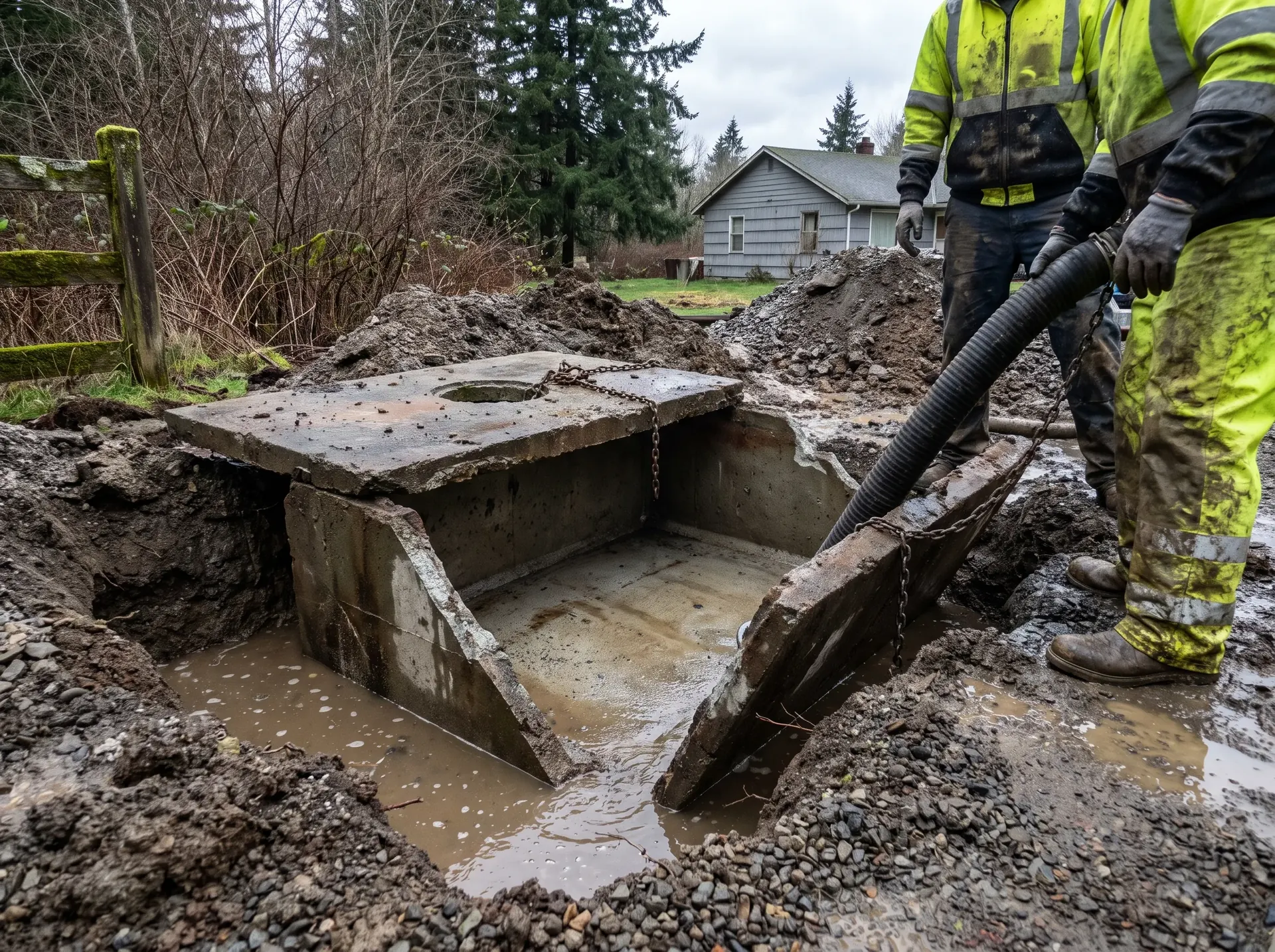
County permit package prepared and submitted, and the old tank pumped, crushed or filled and decommissioned to the required standard.
New system installed, county inspection attended, and the ground genuinely restored rather than left as a mound of spoil and rutted grass.
04How it runs
Most routine visits follow this exact sequence. If yours will not, we say so when you book rather than on the day.
Confirming the system is genuinely at the end, with the reasoning explained and the cheaper alternatives explicitly ruled out.
Test pits and soil logging, groundwater assessment, and establishing where a new system can legally and practically go.
System type and layout, and an itemised number covering decommissioning, installation and reinstatement.
Submitted and followed through county review.
Old system decommissioned, new tank and field installed, inspected.
Ground restored, and you get the new as-built. Keep it somewhere findable.
05Why us
We try not to. That is a strange thing for the replacement page to say and it is the most useful thing on it. The incentive in this trade runs the wrong way: the largest job is the one with the least diagnostic work behind it. Ruling out the cheap causes first is how we would want to be treated.
We decommission the old tank properly. An abandoned septic tank left in the ground is a genuine collapse hazard, and it will surface as a problem at the next property sale. It gets pumped and crushed or filled, and it goes on the record.
We put the ground back. A replacement tears up a substantial part of a yard. Backfilling is not the same as reinstating, and the difference is obvious for years afterwards.
And we are realistic about winter. Heavy excavation on saturated ground makes a worse mess and sometimes a worse result. If a job should wait for drier weather and it safely can, we will say so.
Get a second opinion before you commit. Sometimes it is correct. Often the cheaper causes were never checked.
06What customers say
Placeholder section.No reviews have been collected yet, and nothing here is invented to fill the space. Real customer reviews go in before this section publishes. Until then there is no star rating, no aggregate score and no review markup on this site.
07Questions
Wide range, driven by soil, system type, access and whether an engineered system is required. Our cost guide sets out what moves the number.
A concrete tank can last several decades. The drain field usually reaches the end first, which is why field only replacement is far more common than full replacement.
You cannot conceal one, and a transfer generally cannot complete with an unresolved failure. In practice it becomes a negotiation: fixed before closing, or reflected in the price with the work documented.
Design, permitting and installation are regulated, and this is not realistically a homeowner project. An unpermitted system creates problems at resale as well as health and legal exposure.
It has to be decommissioned rather than abandoned: pumped out, then crushed or filled so it cannot collapse. Leaving it intact and buried is both a hazard and something that will surface during a future sale.
Sometimes. It depends on whether the soil itself has clogged or whether the field is being overwhelmed by something upstream or by groundwater. That is exactly what the assessment is for.
08Coverage
We cover Bellingham, Lynden, Ferndale, Blaine, Birch Bay, Everson, Nooksack, Sumas, Deming, Custer, Sudden Valley and Point Roberts.
09Related
Every other service we run, in case the job you have is not the one you came here for.
Routine and overdue pumping. Both chambers, lids dug out at no extra charge, and the tank inspected while it is open.
Property transfer and routine inspections, with a written report escrow and the county can both act on.
Baffles, lids, risers, pumps, alarms and blocked lines. We diagnose before anyone quotes a replacement.
Whether a saturated field can be recovered or genuinely needs replacing, and the evidence for the call.
New systems from site evaluation and soil testing through design, permit and final county inspection.
Backing up, alarm sounding, sewage surfacing. Same day response, priced before we start.
Finding a buried system on a property where nobody knows where anything is, and tracking down the as-built.
Lids brought to ground level so future service does not start with an hour of digging.
Effluent and grinder pumps, floats and alarm panels on pressurised, mound and sand filter systems.
Test pits, soil logs, a design the ground will support, and a permit package the county will accept.
10Book it
Tell us what has happened, and if you have already had a quote elsewhere, tell us what it said.