New riser installation
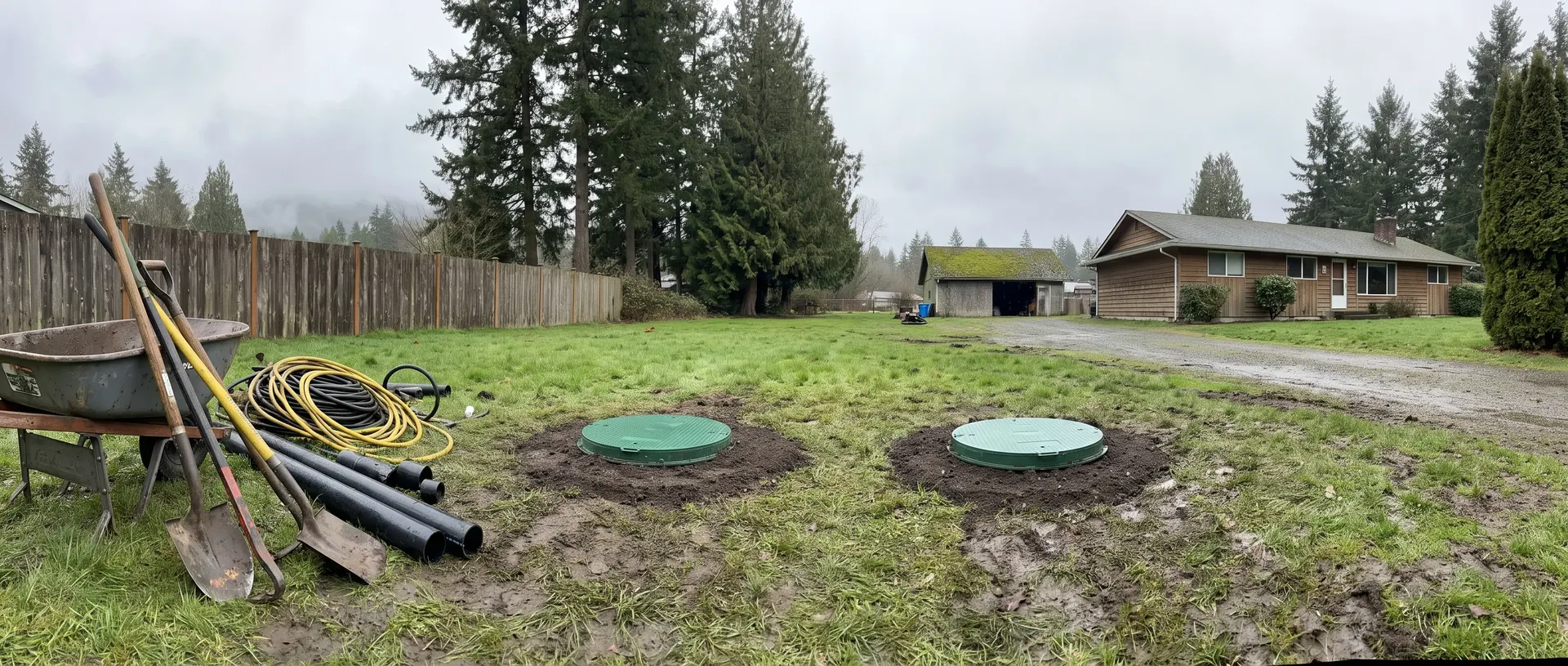
Fitting risers to bring one or both tank openings up to grade, sealed to the tank collar and capped with a secure lid.
Septic service
The cheapest upgrade on a septic system. Lids at ground level, so nobody digs for an hour every time the tank needs attention.
01Why it matters
On a lot of older systems around here, the tank lids sit under a foot or more of soil and turf. Every pump out and every inspection therefore starts with locating them and digging them out, and that labour goes on your invoice each time.
Risers fix it permanently. A riser is a collar that extends the tank opening up to ground level, capped with a secure lid sitting flush with the lawn. Once fitted, access takes seconds.
The arithmetic is simple. Risers usually pay for themselves within two or three service visits, and after that they are saving you money every time. They also make it far more likely that the system gets inspected properly, because the effort barrier is gone.
There is a second benefit that matters more in this climate than most. A properly sealed riser keeps surface water out of the tank. In a county where the ground is saturated for months, water finding its way into the tank through a poorly sealed or cracked lid is real added load on a drain field that does not need any more.
02Scope
Fitting risers to bring one or both tank openings up to grade, sealed to the tank collar and capped with a secure lid.
Replacing cracked, broken or missing lids. A broken septic lid is a genuine safety hazard, not a cosmetic problem, and it should be dealt with immediately.
Risers and access ports on pump chambers, distribution boxes and effluent filter housings, so the whole system can be serviced without excavation.
03Included
Tank collar type and condition, how deep the lids currently sit, and what riser configuration will fit.
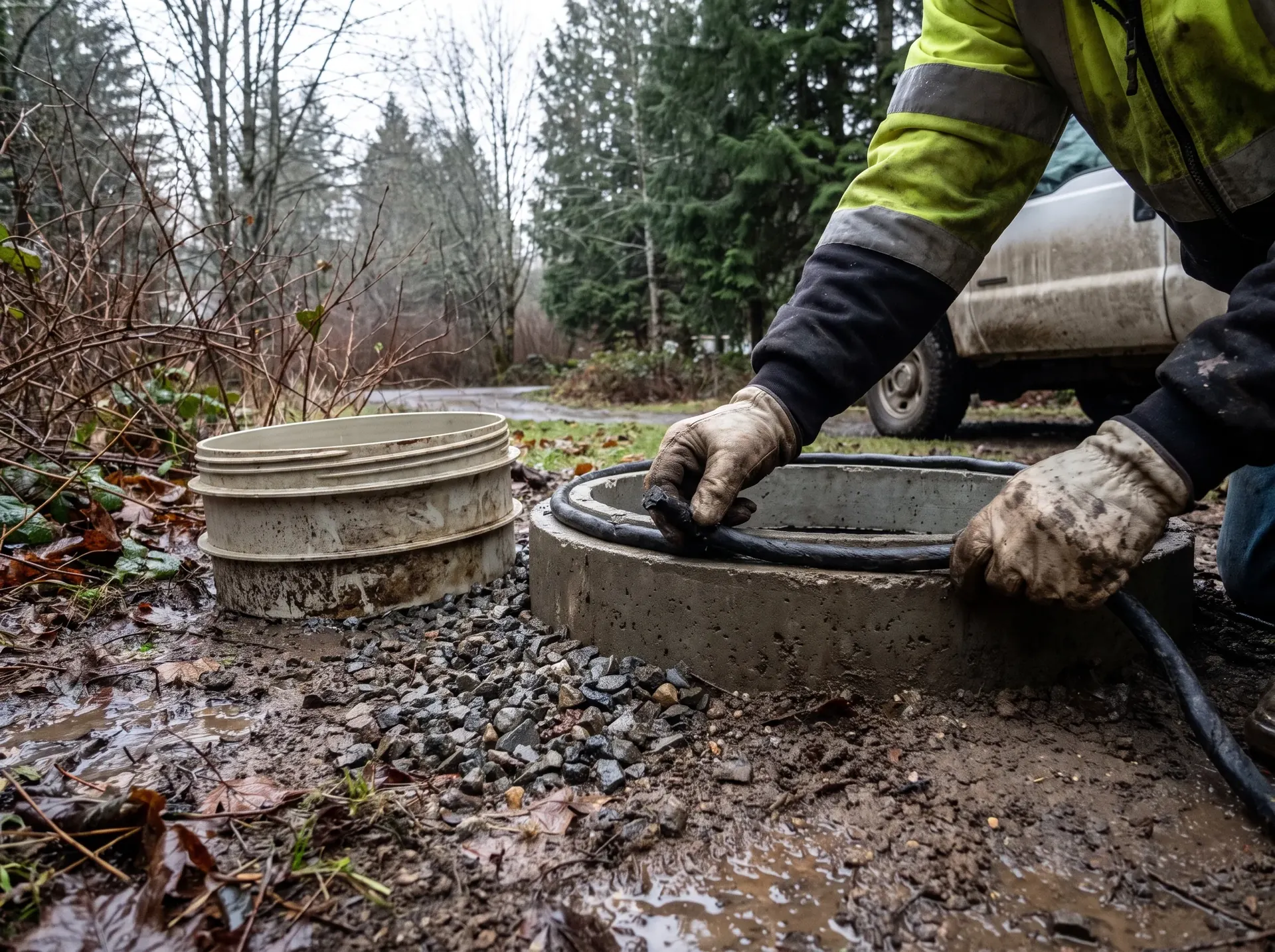
Digging down to the collar, cleaning it, and setting the riser sections to bring the opening to grade.
Sealed to the tank so surface water and roots stay out. This is the step that separates a riser that helps from one that quietly makes things worse.
A lid that fastens rather than simply resting in place, and turf and soil made good around the collar.
04How it runs
Most routine visits follow this exact sequence. If yours will not, we say so when you book rather than on the day.
The tank is already open and the lids are already exposed. This is by far the cheapest time to do it, so we suggest it then.
Condition and dimensions of the existing opening, and how many sections are needed to reach grade.
Cleared and cleaned so the seal has something sound to bond to.
Riser sections set, joints and the tank connection sealed against water ingress.
A secure fastening lid, not a loose cover. Safety matters here more than convenience.
Soil and turf restored around the collar so the lid finishes flush and the mower goes over it without catching.
05Why us
We suggest them at the right moment. If we are already there with the lids dug out for a pump out, that is when risers cost the least. Coming back specially means paying for the same excavation twice.
We seal properly. A riser that is not sealed to the tank becomes a funnel: surface water runs down the outside of the collar and straight into the tank, adding hydraulic load to a drain field that in this county is already dealing with groundwater. A badly fitted riser is worse than no riser.
We fit lids that fasten. An unsecured septic lid at ground level is a hazard, particularly with small children or livestock around. Secure lids are not an upgrade, they are the correct specification.
And we will tell you when it is not worth it. If your lids are already only a couple of inches down, you do not need risers and we will say so.
Add risers to your next pump out. It is the cheapest time to do it and you will not think about it again.
06What customers say
Placeholder section.No reviews have been collected yet, and nothing here is invented to fill the space. Real customer reviews go in before this section publishes. Until then there is no star rating, no aggregate score and no review markup on this site.
07Questions
A collar that extends the tank access opening up to ground level, finished with a lid that sits flush with the lawn. It means the tank can be opened without digging.
It depends on how deep the lids currently are and how many openings you want brought to grade. Fitted during a pump out it is substantially cheaper than as a standalone visit, because the excavation is already done.
If your lids are buried more than a few inches, yes. They typically pay for themselves within two or three service visits, and they make it far more likely that the system actually gets inspected regularly.
A cracked, broken or unsecured lid absolutely is. Tanks are deep and the gases inside are dangerous. Broken lids should be replaced immediately rather than covered over with a board or a paving slab.
The physical work is not complicated. The seal is, and a poorly sealed riser lets surface water into the tank, which adds load to the drain field. Given the excavation is the bulk of the effort, doing it during a pump out is usually the better call.
Only if they are sealed badly. Correctly sealed to the collar and with a proper lid, a riser keeps water out better than a buried lid that nobody has inspected in twenty years.
08Coverage
We cover Bellingham, Lynden, Ferndale, Blaine, Birch Bay, Everson, Nooksack, Sumas, Deming, Custer, Sudden Valley and Point Roberts.
09Related
Every other service we run, in case the job you have is not the one you came here for.
Routine and overdue pumping. Both chambers, lids dug out at no extra charge, and the tank inspected while it is open.
Property transfer and routine inspections, with a written report escrow and the county can both act on.
Baffles, lids, risers, pumps, alarms and blocked lines. We diagnose before anyone quotes a replacement.
Whether a saturated field can be recovered or genuinely needs replacing, and the evidence for the call.
New systems from site evaluation and soil testing through design, permit and final county inspection.
Full replacement when a system is finished, including decommissioning the old tank properly.
Backing up, alarm sounding, sewage surfacing. Same day response, priced before we start.
Finding a buried system on a property where nobody knows where anything is, and tracking down the as-built.
Effluent and grinder pumps, floats and alarm panels on pressurised, mound and sand filter systems.
Test pits, soil logs, a design the ground will support, and a permit package the county will accept.
10Book it
Tell us roughly how deep your lids are, if you know. If you do not know, that is a good sign you need them.